Home / All / Wood Coatings / Water-Based Topcoat / Waterborne Self-Healing Matte Topcoat Manufacture | GOMIN
Waterborne Self-Healing Matte Topcoat Manufacture | GOMIN
Detail Information
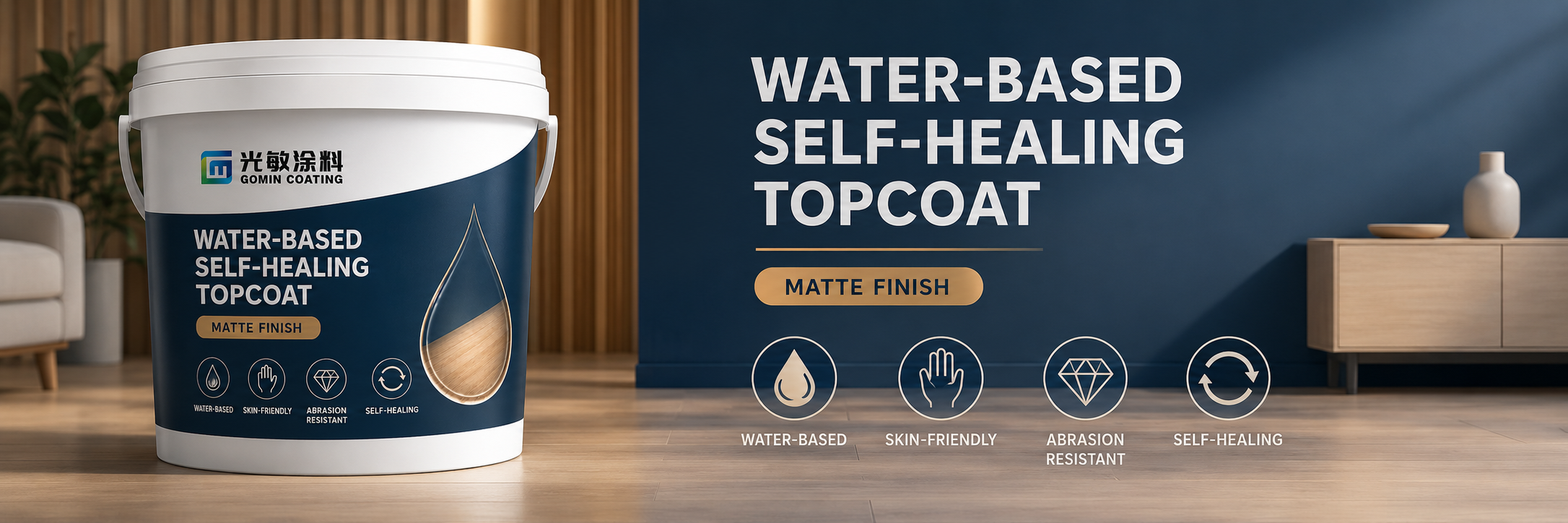
0°
Ultra-Matte
60° gloss angle
4H+
Pencil Hardness
Superior scratch resistance
48h
Water Resistance
No blistering or cracking
Low VOC
Eco-Friendly
GB 18582 / LEED compliant
What Is a Waterborne Self-Healing Matte Topcoat?
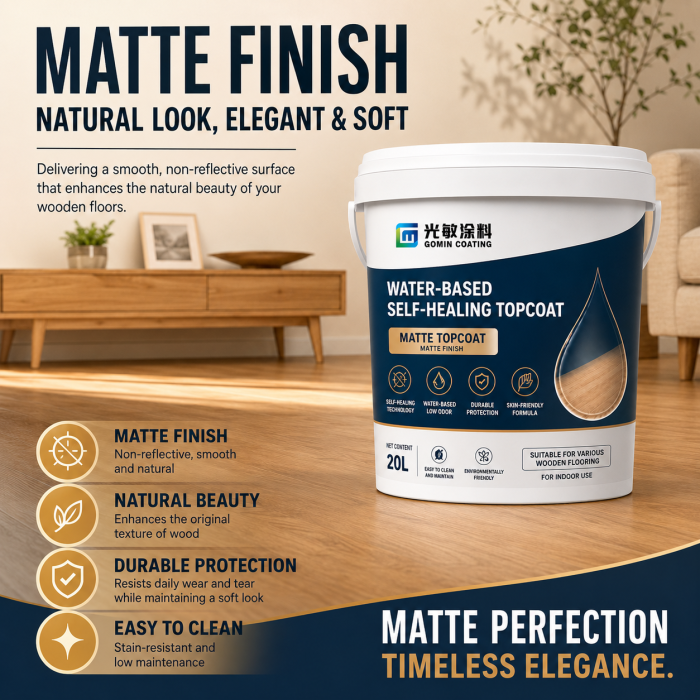
Our Waterborne Self-Healing Matte Topcoat is a premium two-component (2K) water-based clear coat engineered for wood surfaces — including hardwood flooring, solid-wood furniture, cabinetry, and interior millwork. It delivers a genuine 0-degree ultra-matte finish with a distinctive velvety feel, while incorporating advanced self-healing polymer technology that allows light surface scratches to close and recover with gentle heat exposure.
Unlike conventional solvent-borne lacquers, this coating is formulated with ultra-low VOC content, meeting GB 18582, REACH, and California South Coast AQMD standards — making it the ideal choice for LEED-certified projects, commercial interiors, and residential renovations where indoor air quality matters.
Why Specifiers & Manufacturers Choose This Topcoat
01 Water-Based & Eco-Friendly Formula
Formulated with water as the carrier solvent — no benzene, no formaldehyde, no heavy metals. VOC content stays below 80 g/L, passing GB 18582 and aligning with LEED v4 EQ Credit requirements. Low odor during application makes it safe for occupied interiors, shorter production downtime, and reduced personal protective equipment (PPE) needs for finish applicators.
02 Velvety Tactile (Skin-Feel) Surface
The cured film exhibits a uniquely smooth, skin-soft texture — often described as suede or velvet — that distinguishes high-end furniture and flooring from commodity-coated products. This micro-texture is engineered directly into the coating chemistry, not achieved through post-application buffing, ensuring long-term consistency across large production runs.
03 Scratch & Abrasion Resistance
Achieves 4H+ pencil hardness and passes 500g/200-cycle Taber abrasion testing with no significant film loss. Ideal for high-traffic hardwood floors, dining table tops, and commercial furniture that must maintain a flawless appearance under intensive daily use. Outperforms many solvent-based matte coatings in comparable hardness benchmarks.
04 Self-Healing Technology
A proprietary elastic polymer network within the film enables minor scratches to self-repair when exposed to temperatures of approximately 45–60°C (113–140°F) — achievable via warm towel, heat gun on low, or direct sunlight. Up to 90% recovery of scratch depth in 30 minutes. Reduces the need for touch-ups, lowers lifetime maintenance costs, and extends the rated service life of the finish.
05 True 0-Degree Ultra-Matte Gloss
Measured at 60° geometry per ASTM D523, this topcoat achieves a gloss reading of ≤1 GU — a genuine ultra-matte rather than a standard 'flat' finish. The result is a pure, non-reflective surface that reads as natural wood or fine leather, with zero light scatter artifacts. Consistent across batches, making it suitable for large-scale production where sheen uniformity is critical.
Recommended Substrates & Use Cases
This waterborne matte topcoat is optimized for interior wood surfaces where the combination of aesthetics, durability, and environmental compliance is paramount:
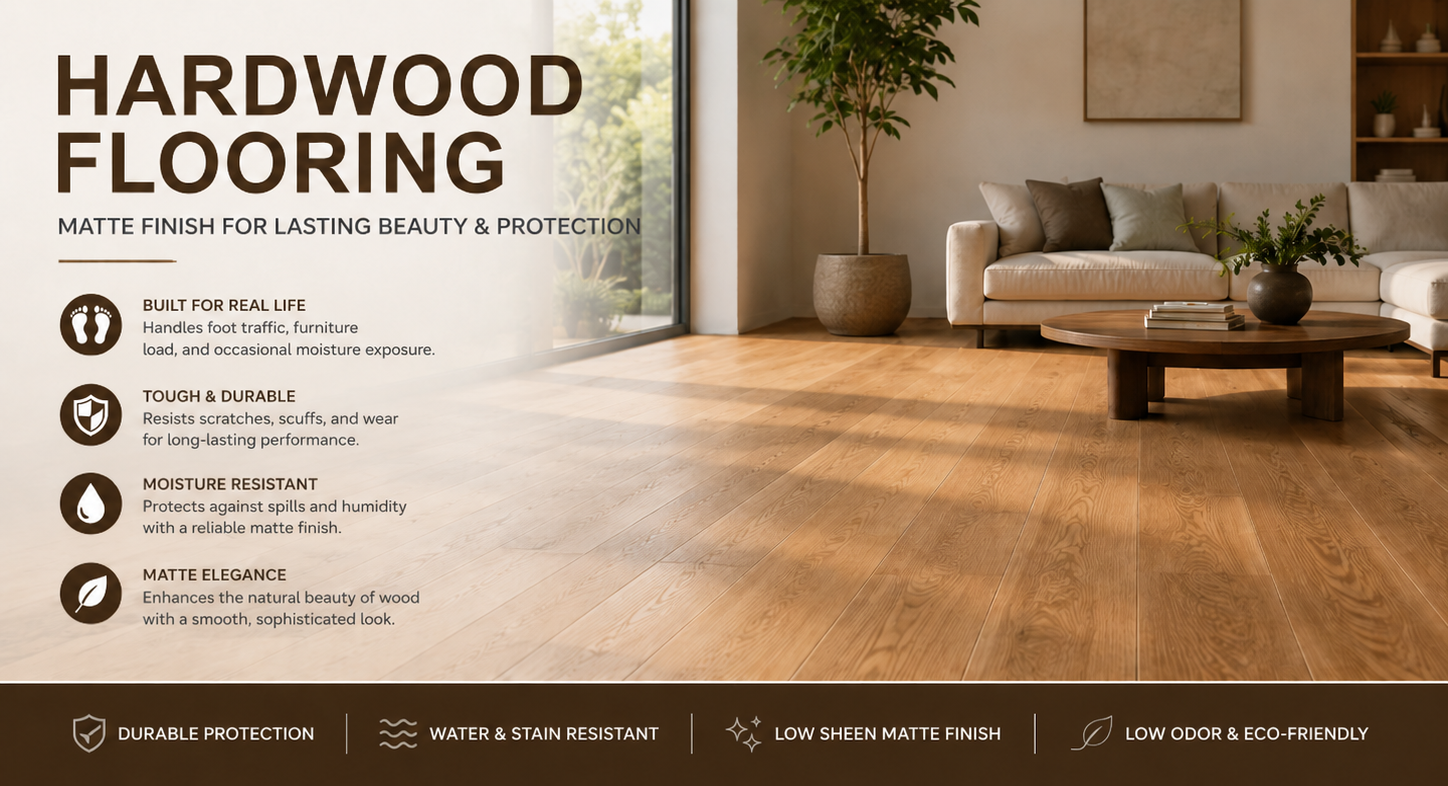
Hardwood Flooring
Primary use case. Handles foot traffic, furniture load, and occasional moisture exposure.
• Residential & commercial hardwood floors
• Engineered wood flooring finish layers
• Sports hall & dance studio wood floors
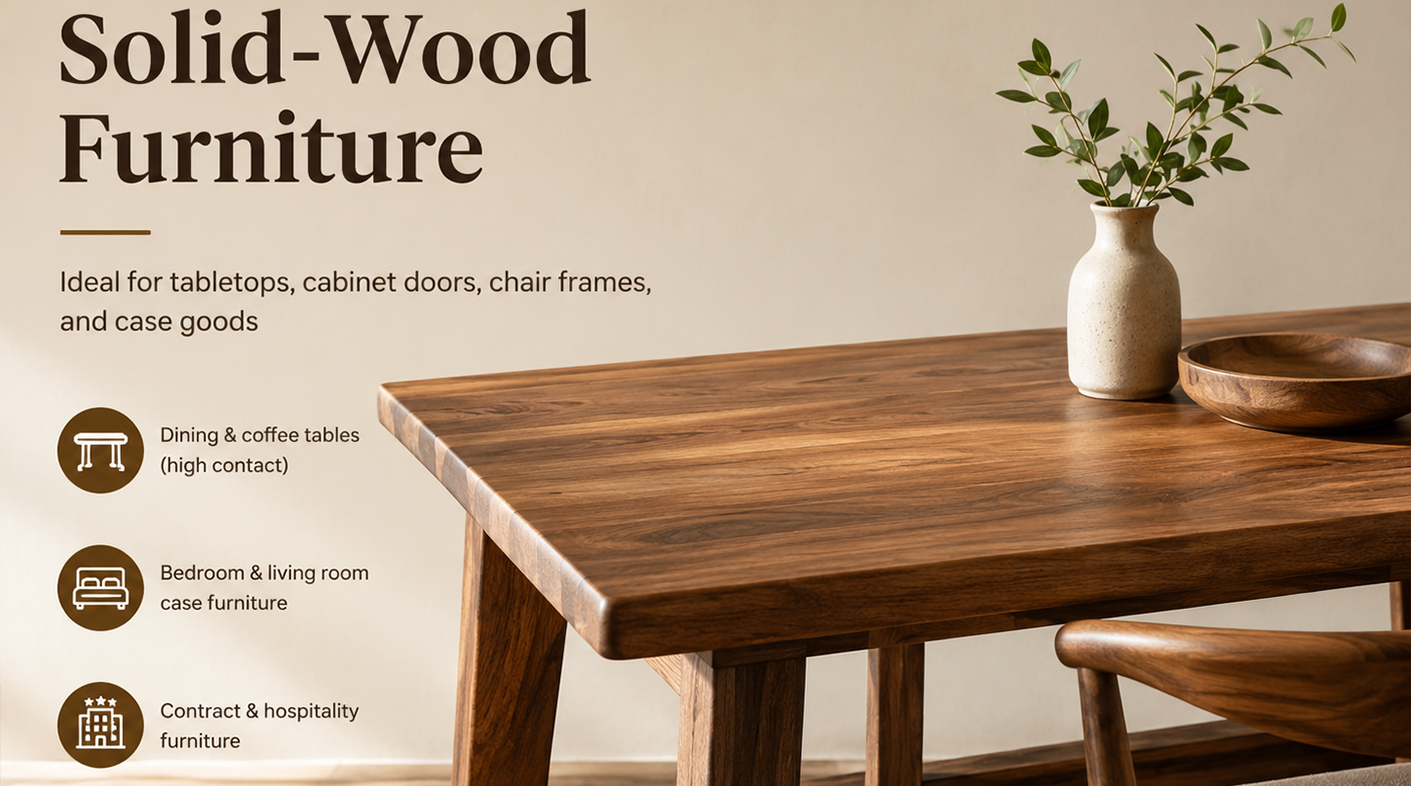
Solid-Wood Furniture
Ideal for tabletops, cabinet doors, chair frames, and case goods.
• Dining & coffee tables (high contact)
• Bedroom & living room case furniture
• Contract & hospitality furniture
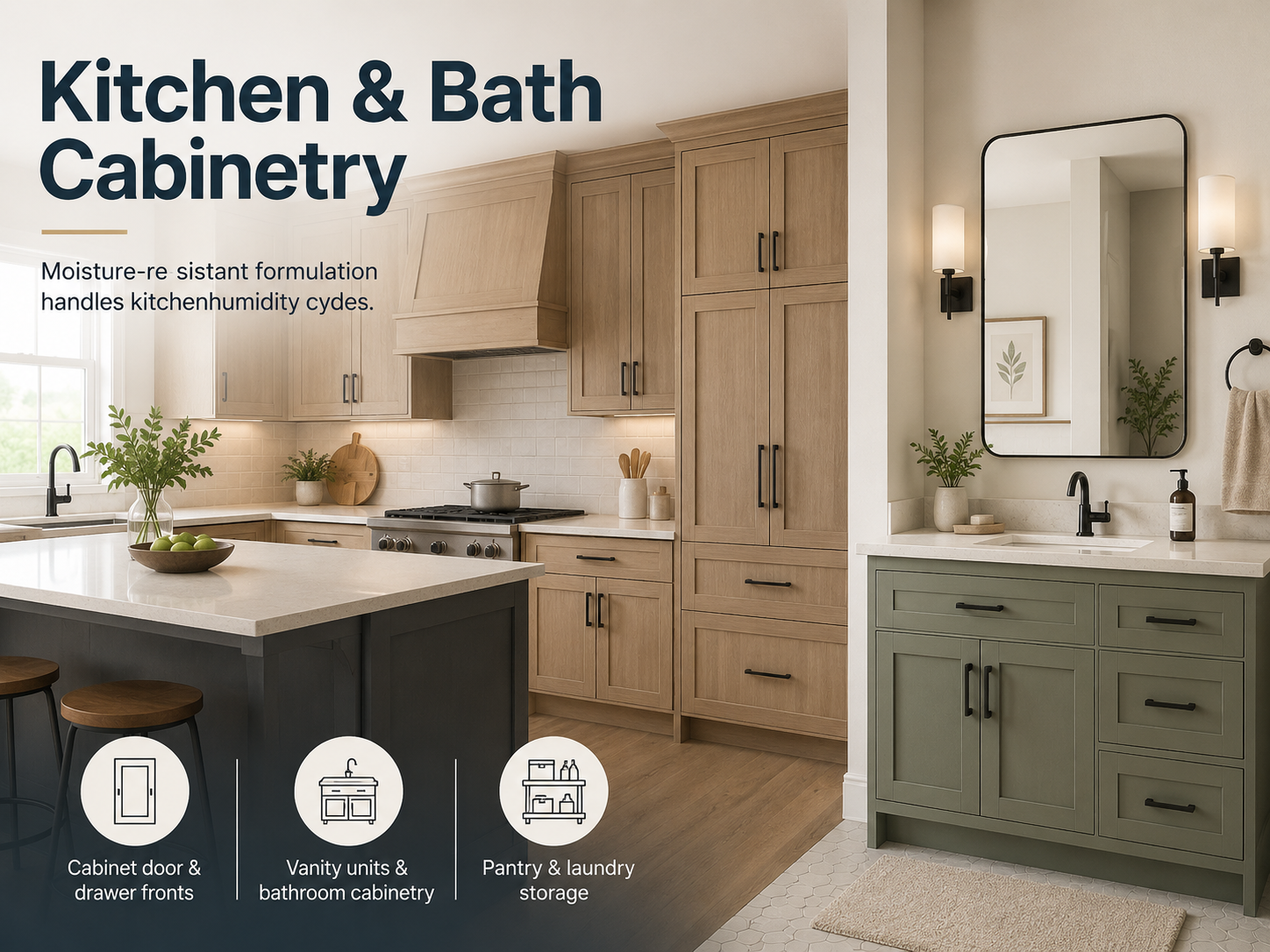
Kitchen & Bath Cabinetry
Moisture-resistant formulation handles kitchen humidity cycles.
• Cabinet door & drawer fronts
• Vanity units & bathroom cabinetry
• Pantry & laundry storage
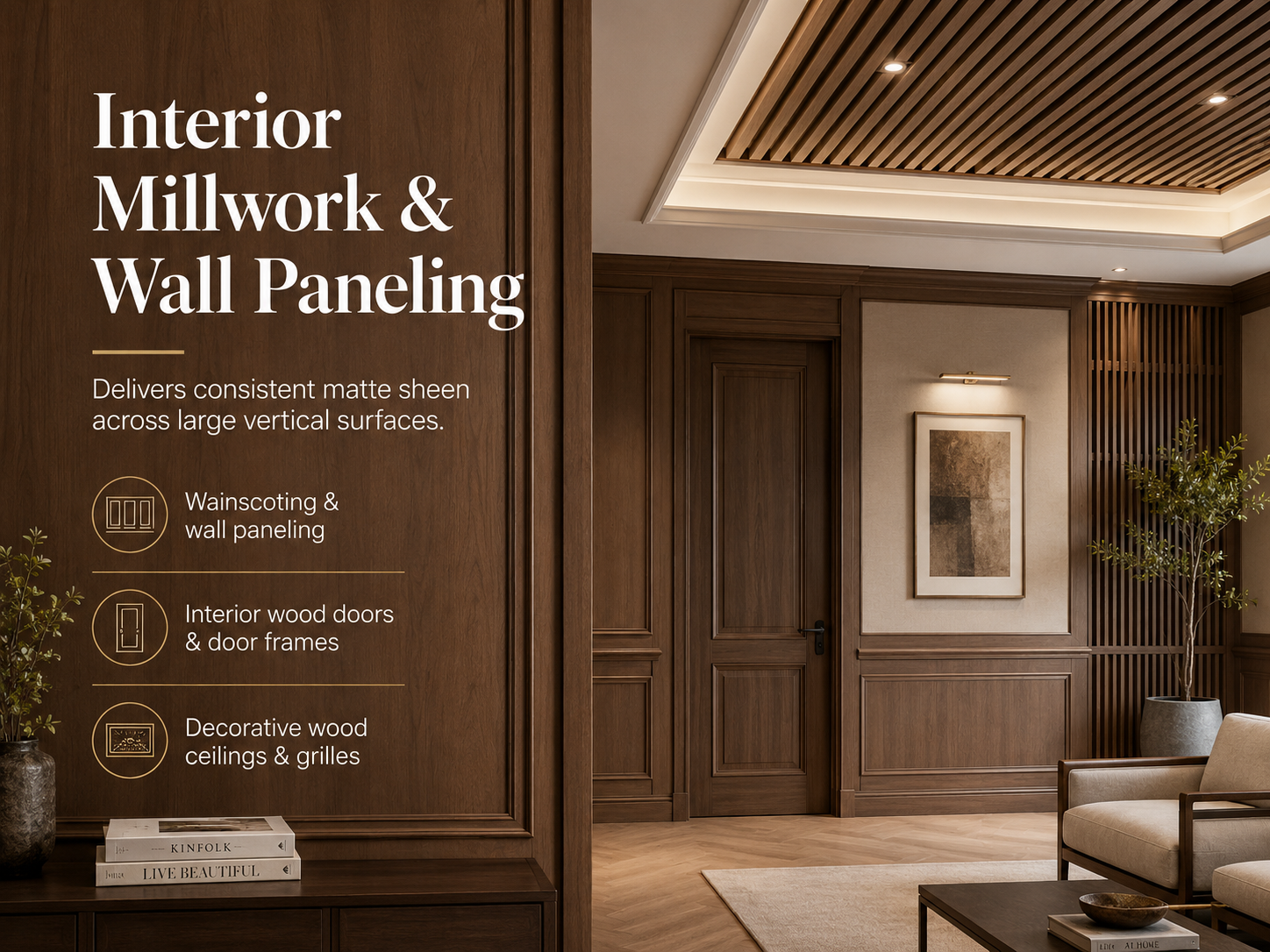
Interior Millwork & Wall Paneling
Delivers consistent matte sheen across large vertical surfaces.
• Wainscoting & wall paneling
• Interior wood doors & door frames
• Decorative wood ceilings & grilles
Performance & Application Data
| PERFORMANCE PROPERTIES | |
| Gloss Level (60°) | ≤ 1 GU (0-degree ultra-matte) |
Pencil Hardness | ≥ 4H |
| Adhesion (Cross-Cut) | Grade 0 per ISO 2409 |
| Abrasion Resistance | 500g / 200 cycles — no significant loss (Taber) |
Self-Healing Rate | ≥ 90% scratch depth recovery @ 60°C / 30 min |
Water Resistance | 48h immersion @ 25°C — no blistering or delamination |
Chemical Resistance | Resistant to ethanol, soy sauce, coffee, household cleaners |
UV Resistance | Passes 300h QUV-A without significant yellowing |
| APPLICATION PARAMETERS | |
| Coating Type | 2K Water-Based Polyurethane Topcoat |
Mix Ratio (A:B) | Per TDS — typically 10:1 by weight |
| Solid Content | ≥ 40% |
| Application Viscosity | 25–35 sec (DIN 4 cup, spray-ready after thinning) |
Application Methods | HVLP Spray / Roller / Brush |
Thinner | Deionized water — max 10% by volume |
Theoretical Coverage | 8–12 m² per kg per coat |
Dry Times @ 23°C | Touch-dry: 30 min | Through-dry: 24h | Full cure: 7 days |
VOC Content | ≤ 80 g/L (mixed, ready-to-apply) |
Pot Life @ 23°C | Approx. 4 hours after mixing |
Shelf Life (unmixed) | 12 months in original sealed container |
Storage Conditions | 5°C – 35°C, away from direct sunlight and frost |
Waterborne Topcoat vs. Oil-Based Matte Lacquer — Key Differences
| COMPARISON TABLE | |
| Property | Waterborne (This Product) vs. Solvent-Borne |
| VOC Content | ≤ 80 g/L (Low VOC) vs. 300–600 g/L (High VOC) |
| Odor During Application | Low — suitable for occupied spaces vs. Strong — requires ventilation |
Dry Time | Touch-dry ~30 min vs. 60–120 min |
Pencil Hardness | ≥ 4H (comparable) vs. 3H–4H |
Yellowing Resistance | Excellent (waterborne clarity) vs. Moderate (amber tint over time) |
Self-Healing | Yes (proprietary) vs. No |
Environmental Compliance | GB 18582 / LEED / REACH vs. Restricted in many jurisdictions |
Indoor Air Quality | Safe for occupied interiors vs. Evacuation required |
How to Apply Waterborne Self-Healing Matte Topcoat
Step 1 — Surface Preparation
Sand wood surface to 150–180 grit. Remove all sanding dust with a tack cloth or vacuum. Ensure substrate moisture content is 6–12% for dimensional stability. Apply a compatible waterborne sealer or grain filler before topcoat where required.
Step 2 — Mixing
Combine Component A (resin) and Component B (hardener/crosslinker) at the specified ratio. Mix thoroughly for 3–5 minutes. Allow to induct for 5 minutes before application. Do not exceed pot life (approx. 4 hours at 23°C).
Step 3 — Application
Apply by HVLP spray gun (1.4–1.8mm tip) at 2.0–2.5 bar air pressure. Maintain a wet-edge technique. Apply 2–3 coats, lightly sanding (320 grit) between coats after full dry. For roller application, use a short-nap foam roller to minimize texture.
Step 4 — Curing
Allow 24 hours through-dry at 23°C and 50% RH before light service. Full hardness achieved at 7 days. Avoid heavy water exposure or chemical contact during the first 7 days. Forced drying (50–60°C) is permissible to accelerate cure in production environments.
Compatible Primer Systems
•Waterborne 2K Sanding Sealer (recommended — same chemistry for optimal adhesion)
•Waterborne UV-cured sealer (test compatibility prior to bulk production)
•Waterborne grain filler for open-grain species (oak, ash, walnut)
FAQ — Waterborne Self-Healing Wood Topcoat
Q1 What wood surfaces is this matte topcoat suitable for?
It is designed for all interior wood surfaces: hardwood and engineered wood floors, solid-wood furniture (tables, chairs, cabinets), kitchen cabinet doors, interior doors, wall paneling, and decorative millwork. It performs equally well in residential and commercial settings.
Q2 What does '0-degree ultra-matte' mean in practical terms?
A 0-degree or ultra-matte finish has a 60° gloss reading of ≤1 GU. Standard 'flat' or 'matte' paints typically measure 5–15 GU. At ≤1 GU, the surface appears virtually reflectionless — the visual result is very similar to an unfinished wood or a fine suede surface. This is the lowest gloss level commercially achievable in a durable topcoat.
Q3 How does the self-healing feature actually work?
The film contains an elastic polymer network engineered with shape-memory properties. When a light scratch disrupts surface chains, gentle heat (45–60°C / 113–140°F) provides the activation energy needed for the polymer chains to realign and close the scratch. Common heat sources: a warm damp cloth, a low-setting heat gun, or direct summer sunlight. Deep gouges that penetrate through to the wood substrate are outside the self-healing range.
Q4 Is this product compliant for LEED-certified commercial projects?
Yes. With VOC content ≤80 g/L (ready-to-apply), it meets the threshold for LEED v4 EQ Credit: Low-Emitting Materials (Paints & Coatings category). Request the current SDS and VOC compliance letter from your sales representative.
Q5 What primer or sealer should I use underneath?
For best adhesion and optimal matte uniformity, use a compatible waterborne 2K sanding sealer from the same product line. Applying over incompatible solvent-based primers can cause fisheye, adhesion failure, or sheen variation. Always run a small-area adhesion test when mixing coating brands.
Q6 How do I maintain and clean an ultra-matte wood finish?
Daily cleaning: wipe with a slightly damp microfiber cloth — avoid abrasive pads or harsh detergents that erode the matte surface. Stubborn stains: use a pH-neutral cleaner applied briefly, then wipe dry. Never use wax polishes or silicone-based products; they fill the micro-texture and create sheen inconsistencies. Felt pads on furniture legs are strongly recommended on matte-finished floors.
Related Products
Review
- 加载中···
Please send your message to us
- Name
- Phone
- *Title
- *Content

Choose GOMIN COATING
China Coatings Expert
Contact Person

Please send your message to us
- Name
- Phone
- *Title
- *Content