GMS-6128 Modified Epoxy Acrylate Resin for UV Vacuum Metallization



| Share | |
|---|---|
| Categories | UV Resins & Raw Materials |
| Brand | Gomin Industry Coating Wholesale Manufacturer |
| Product Specifications | GMS-6128 |
| Product Code | GMS-6128 |
| Product Type | UV-curable resin (oligomer) |
| Chemistry | Modified epoxy acrylate (difunctional) |
| Appearance | Slightly yellow, clear transparent liquid |
| Functionality | 2 |
| UV Component | 100 % |
| Viscosity @ 60 °C | 2,000-4,500 cps |
| Colour | ≤ 1 (colour scale not stated on the TDS) |
| Acid Value | ≤ 3 mg KOH/g |
| Refractive Index | 1.531 (test conditions not stated) |
| Shore Hardness | 67D (cure conditions not stated) |
| Typical Applications | Vacuum metallization base & top coats; wood; paper varnish; UV inks; plastic OPV; nail gel |
| Packaging | 20 kg / 200 kg drums |
| Shelf Life | 6 months at 25 °C, ventilated, kept sealed |
| Storage | Keep sealed, ≤ 30 °C, away from heat and sunlight |
GOMIN / UV RESINS & RAW MATERIALS
GMS-6128 is a difunctional modified epoxy acrylate oligomer for UV vacuum metallization base and top coats, paper soft-touch varnishes, UV inks and plastic overprint varnishes. The TDS lists 2,000–4,500 cps @ 60 °C, 100 % UV component, Shore hardness 67D and acid value ≤ 3 mg KOH/g — a slightly yellow clear liquid supplied in 20 kg and 200 kg drums.
2
Functional groups
100 %
UV component
2,000–4,500
cps @ 60 °C
67D
Shore hardness
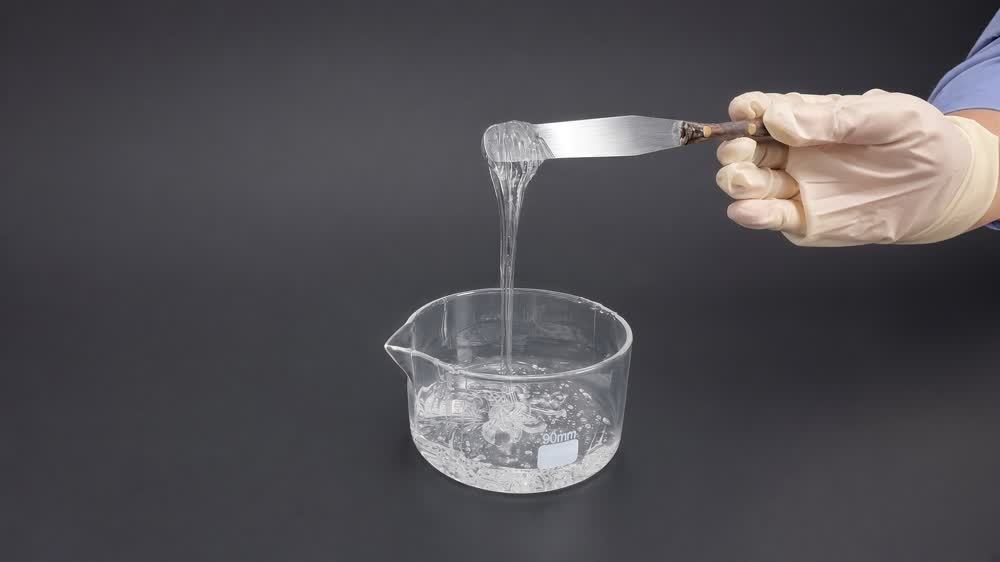
Generic clear UV resin during laboratory handling; an illustration, not a labelled GMS-6128 container.
What Is GMS-6128?
On the manufacturer's Chinese-language TDS the product name literally reads "modified UV epoxy resin", while the introduction identifies the chemistry as a modified epoxy acrylate resin. Buyers seeking a conventional two-part thermoset epoxy should note the distinction. Sourcing terms for this single grade include modified epoxy acrylate, epoxy acrylate oligomer and vacuum metallization base coat resin.
It is a slightly yellow, clear transparent liquid. The TDS lists functionality 2, viscosity 2,000–4,500 cps @ 60 °C, UV component 100 %, acid value ≤ 3 mg KOH/g and Shore hardness 67D, plus colour ≤ 1 and refractive index 1.531. These values form the incoming QC baseline. See our UV Resins & Raw Materials range.
Why Are Vacuum Metallization UV Coatings Hard to Balance?
A 100 % UV-component oligomer such as GMS-6128 is handled at 2,000–4,500 cps @ 60 °C, and on a metallization line the base coat cures in seconds, leaving little time for levelling. In vacuum metallization a very thin metal layer is deposited onto a UV-cured film, so any orange peel, crater or shrinkage stress is amplified by the metal. That layer must then survive the topcoat, handling and often a flexible substrate.
In UV metallization systems, fullness, gloss and levelling are judged before hardness because metal reveals surface defects; wetting sets interfacial adhesion; flexibility limits cracking when the part bends. These are general system behaviours, not a claim about one grade. For GMS-6128 the TDS lists high fullness, high gloss and high levelling, good wetting on various substrates, metallisation suitability, good flexibility, toughness, scratch resistance, a relatively fast cure, resistance to thinning or dilution, and balanced overall performance. No numerical limit is added here.
The table keeps the TDS wording on the left and the problem it addresses on the right. It lists features, not measured limits.
| Feature stated in the TDS | Formulation problem it addresses | Where it is most relevant |
|---|---|---|
| High fullness, high gloss, high levelling | Surface defects show through the metal layer | Metallization base coats; varnishes |
| Good wetting on various substrates | Craters and weak interfacial adhesion | Plastic, metal, paper, wood |
| Metallisation suitability | Base coat must accept and hold metal | Metallization primers and top coats |
| Flexibility, toughness, scratch resistance; thinning resistance | Cracking, handling marks, let-down stability | Wood; UV inks; nail gel; dilution |
Where GMS-6128 Fits
The TDS names vacuum metallization base and top coats, wood, paper soft-touch varnish, UV inks, plastic overprint varnish and UV nail gel as typical uses, adding metal and plastic clear UV coatings plus structural adhesives. The 100 % UV-component figure applies to all of them.
| Application | What the film has to survive | What the TDS lists for this grade |
|---|---|---|
| Vacuum metallization base & top coats | Metal deposition, adhesion, mirror smoothness | Metallisation suitability, fullness, gloss, levelling |
| Plastic overprint varnish & metal clear coats | Scratches, clarity, low-energy surfaces | Substrate wetting, scratch resistance, clear liquid |
| Paper soft-touch varnish, UV inks, nail gel & structural adhesives | Levelling, line speed, flexing | Levelling, fast cure, thinning resistance, flexibility |
Where it is NOT the answer
- Quantified high-elongation specifications — GMS-6050A or GMS-6136 publish elongation data; the GMS-6128 TDS describes flexibility only qualitatively.
- Six-functional high-crosslink protective varnishes — GM-1236306. GMS-6128 is difunctional with Shore hardness 67D.
- Low-odour white wood paint — GMS-3323D carries an explicit odour claim; the GMS-6128 TDS does not address odour. Do not assume either way.
The TDS publishes no numerical VOC, density, cure shrinkage or Tg, names no colour scale for the ≤ 1 figure, and states no test conditions for refractive index or the 67D hardness value. Request and verify those separately.
Technical Specifications
All values below come from the GMS-6128 TDS. Viscosity is measured at 60 °C, not 25 °C.
Generic clear resin pour, shown for illustration only.
| Product code | GMS-6128 |
|---|---|
| Chemistry | Modified epoxy acrylate, difunctional |
| Appearance | Slightly yellow, clear transparent liquid |
| Functionality | 2 |
| UV component | 100 % |
| Viscosity | 2,000–4,500 cps @ 60 °C |
| Colour | ≤ 1 (colour scale not stated on the TDS) |
| Acid value | ≤ 3 mg KOH/g |
| Refractive index | 1.531 (test temperature and wavelength not stated) |
| Shore hardness | 67D (cure conditions not stated) |
| Typical applications | Vacuum metallization base & top coats; wood; paper varnish; UV inks; plastic OPV; nail gel |
| Packaging | 20 kg / 200 kg drums |
| Shelf life | 6 months at 25 °C, ventilated, kept sealed |
Values reproduced exactly from the GMS-6128 TDS, Dalian Gomin Special Coating Co., Ltd — not extrapolated, rounded or supplemented from other grades. The TDS gives no numerical VOC, density, cure shrinkage or Tg, no colour scale, and no test conditions for refractive index or hardness. Viscosity is quoted at 60 °C — do not compare directly with grades quoted at 25 °C.
Formulation & Processing Guidance
At 2,000–4,500 cps @ 60 °C the resin is handled warm, and the TDS lists resistance to thinning but fixes no dosage. The steps below are trial guidance, not a production formula.
Step 1 — Start with the substrate and the metallization step
Decide whether the part is plastic, metal, paper or wood, and where the metal layer is deposited. Run a draw-down on the real substrate and check wetting and adhesion before and after deposition. Good wetting is listed on the TDS; the pass criterion is yours to set, because no adhesion value is published.
Step 2 — Build fullness and levelling before chasing hardness
On a metallized surface the metal amplifies every defect, so judge fullness, gloss and levelling under the customer's viewing angle. Let down the resin stepwise and watch the viscosity; the TDS lists high fullness, high gloss and high levelling, but no recommended let-down ratio.
Step 3 — Confirm cure and metallisation on your own line
A relatively fast cure and metallisation suitability are TDS statements, not a lamp setting. Confirm dose, line speed and deposited-layer adhesion on your equipment, then re-check after the topcoat. A film that looks perfect before metallization can still fail the tape test.
Generic flow demonstration, not a GMS-6128 viscosity measurement.
Recommended loading is application-specific; the TDS fixes no dosage and we prefer not to guess one. MOQ, lead time, Incoterms and shipping classification are confirmed per inquiry.
Packaging, Storage, Documentation & Quality Control
The TDS states a safe storage period of 6 months at 25 °C under ventilated conditions, in sealed 20 kg or 200 kg drums. Keep containers closed, away from heat and direct sunlight, at no more than 30 °C; partly used material must be resealed promptly, because the product is highly reactive and can gel in the drum.
Appearance, viscosity, acid value and colour are the release checks against the TDS values above. Batch test data, the SDS, samples and the full TDS are available on request; MOQ, lead time, Incoterms and palletisation are confirmed per inquiry.
- Documents to request: full TDS, SDS, sample, batch test data.
- Order details to confirm: MOQ, lead time, Incoterms, destination port.
- Verify separately: VOC, density, shrinkage, Tg, colour scale, test conditions.
Frequently Asked Questions
What is GMS-6128 used for?
GMS-6128 is a difunctional modified epoxy acrylate listed for UV vacuum metallization base and top coats, wood coatings, paper soft-touch varnish, UV inks, plastic overprint varnish and UV nail gel. The TDS also names metal and plastic clear UV coatings and structural adhesives.
Is GMS-6128 a conventional two-part epoxy resin?
No. The Chinese product name literally reads "modified UV epoxy resin", but the TDS introduction identifies the chemistry as a modified epoxy acrylate resin — a UV-curable acrylate oligomer with a functionality of 2. Treat this as a different chemistry from a conventional two-part thermoset epoxy and request the full TDS before qualifying it.
How should I read the 2,000–4,500 cps viscosity value?
Read it with its test condition: 2,000–4,500 cps @ 60 °C, as printed on the TDS. Viscosity falls steeply as temperature rises, so a 60 °C value is not directly comparable with a grade quoted at 25 °C; confirm the measurement method before placing two resins side by side.
Is GMS-6128 an oligomer or a reactive diluent?
It is an oligomer. The TDS describes a modified epoxy acrylate resin with a functionality of 2 and a 100 % UV component, which is how a film-forming oligomer is specified, whereas a reactive diluent lowers viscosity rather than building the film. No recommended loading figure is published.
What does metallisation suitability mean on this TDS?
The TDS states suitability for metallisation and recommends the grade for vacuum metallization primers and top coats. That is a qualitative feature statement, not a measured adhesion or reflectance value; confirm the deposited layer's appearance and adhesion on your own substrate and lamp settings.
Does the TDS publish VOC, density or shrinkage values?
No. The TDS publishes appearance, viscosity at 60 °C, colour, UV component, acid value, refractive index, Shore hardness and functionality, but no numerical VOC, density, cure shrinkage or Tg. It also omits the colour scale and the test conditions for refractive index and hardness.
What storage temperature and shelf life apply to GMS-6128?
Keep the drums sealed, away from heat and direct sunlight, at no more than 30 °C. The TDS gives a safe storage period of 6 months at 25 °C under ventilated conditions, and warns that partly used material must be resealed immediately because the resin can polymerise and gel.
Is GMS-6128 odor-free after curing?
The TDS does not address odour at all, so we make no odour claim for GMS-6128, before or after cure. If low odour is a purchasing requirement, say so in your inquiry and we will confirm it against batch data; GMS-3323D carries an explicit odour statement.
Which GOMIN grade suits flexible or high-elongation coatings?
GMS-6128 is described as having good flexibility and toughness, but its TDS gives no elongation figure. Where a quantified elongation is required, look instead at GMS-6050A or GMS-6136, both urethane acrylates with elongation data on their own pages. The choice also depends on your substrate.
Can I request a sample, TDS, SDS and a quotation?
Yes. Samples, the full TDS, the SDS and batch test data are available on request. Tell us your substrate, current system and the problem you are solving, and we will send the relevant documentation; price, MOQ, lead time and Incoterms are confirmed per inquiry.
Request a Quote, a Sample or the Full TDS
Include these six points so we can confirm the right oligomer for your line:
- Substrate and the finished product it goes into.
- Coating layer: base coat, top coat, varnish, ink or adhesive.
- Your current resin system and the failure or target you want to fix.
- UV curing equipment, lamp type and line speed.
- Target performance and the test method you will judge it by.
- Estimated monthly volume, destination port and documents needed.
Or write to mesco@mescogroup.com.cn.
Data Source and Disclaimer
All technical values on this page are taken from the GMS-6128 Technical Data Sheet (Chinese product name: "modified UV epoxy resin") issued by Dalian Gomin Special Coating Co., Ltd. The manufacturer describes the data as accurate but not a product specification, accepts no legal responsibility for recommended parameters, and gives no guarantee because conditions of use lie outside its supervision and its products are used with other materials. Buyers must validate suitability in their own formulations. Content source reviewed 20 November 2026.
Unpublished values — VOC, density, shrinkage, Tg, colour scale, test conditions, dosage, MOQ and lead time — are marked unverified or confirmed per inquiry. No value is extrapolated from another grade.
- 加载中···
- Name
- Phone
- *Title
- *Content


- Name
- Phone
- *Title
- *Content